What I Read in April
Mostly good books + a pan review at the end
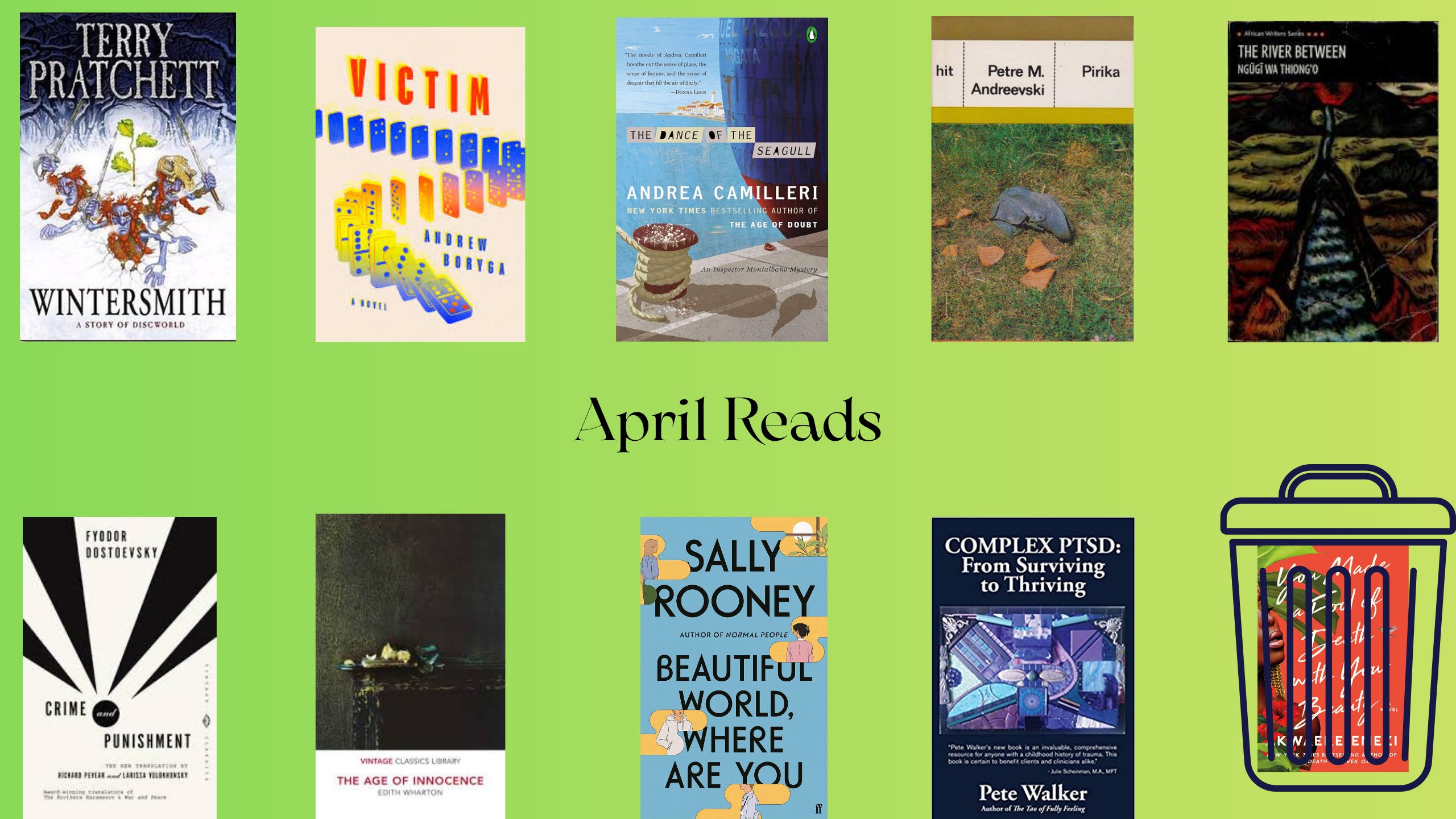
April was a pretty productive reading month for me, not just in terms of the quantity of reading, but in the quality of the books I read - some interesting genre reads, lots of interesting classics, and one which…will be discussed at the end of this round-up.
Wintersmith - Terry Pratchett
I’m continuing my quest through Discworld, focusing on the Tiffany Aching books first. This was my favorite so far. Pratchett really lets the narrative mature with Tiffany, giving her bigger challenges in each book. I really loved this dynamic with the Wintersmith here, I think that Pratchett manages to capture some of the nuance in (I really hate to use this term but it seems the most appropriate) paranormal romance. He captures the tension between the real appeal that the Wintersmith has for a young teenager, showing how this could be romantic, while never romanticizing this relationship or overlooking the power imbalance.
Victim - Andrew Bordyga
I read this for Martha Adams’s book club, and we had a really lively discussion about it. I was a lot more positive about it than most of the people, at least in my session, maybe because as someone from New York, who went to a school similar to Javi’s fictionalized school, and was a first generation college student myself who had to navigate this choice of packaging my trauma for potential gain (for the record, my choice was very different from Javi’s, and I do still wonder if I could have gotten into a better college had I chose differently). This novel is a satire of the victim complex, and like most satirical novels, it does fall flat on characterization and plot development at times.
The Dance of the Seagull - Andrea Camilleri
Also continuing is my quest through the Inspector Montalbano books, which have probably spoiled me for other detective novels. Camilleri manages to weave in some pretty poetic language, cutting critiques of the Italian political establishment, and a weaving network of references to literature and in this installment, Montalbano’s own TV series. The image of the dancing seagull at the beginning was really evocative. However, the middle-aged horndog antics are getting a bit repetitive. Not to get too stereotypical, but there’s only so much you can expect from old Italian men.
Pirika - Petre M. Andreevski
This was another book club pick, this time for my Balkan book club. After a few disappointing choices, we wanted to go back and read a few classics, so we chose this Macedonian classic. The novel is set in a Macedonian village during the Balkan Wars and World War One and split into two perspectives, Velika, and her husband, Jon. Andreevski covers a lot of ground in this novel: nationalism, the cycle of violence in Balkan families, exploitation and poverty’s role in this cycle, shame, and the relationship with the land, among other themes. It honestly was a palate cleanser to read a book written from a time outside of the modern publishing machine (not to sound too much like Javi from Victim here). I also have a working theory about the difference between books that cover traumatic topics such as this one and what I’ve termed “hold-your-children-tight” literature, which I’ll write about more in another post!
I would also like to take this book and use it to beat over the head the following: people who romanticize the past, people who romanticize village life, anti-vaxxers, people who romanticize war, tradwives, guys who say “our grandmas used to give birth in the fields.”
The River Between - Ngũgĩ wa Thiong’o
Continuing my run of the world’s classics, I finally read this work from Thiong’o which has been sitting on my shelf for years. This is one of the books where I really want to read some secondary literature, (especially from African feminist scholars, I’m curious about their interpretations of his female characters), because I feel as if there’s so much more there below the service that I would like to understand. I really found the tension he describes between Christianity and the traditional ways interesting, and the way it turns into a mutually radicalizing effect, very often playing out across the bodies of women. The character of Waiyaki and his very Messianic journey is also so beautifully written.
Crime and Punishment - Fyodor Dostoyevsky
I’m not going to write a lot about this book because I feel as if I can’t say anything intelligent that people haven’t said before, and this is another one where I want to read some secondary literature (please let me know any recommendations). I wish I’d had this in a physical copy so I could underline, annotate, and reread passages more easily than on my Kindle.
The Age of Innocence - Edith Wharton
This was potentially my favorite read of the month, and my first book of Wharton’s. There’s so much I was struck by, but on the sentence level, Wharton has some of the best craft I’ve ever read. Just one example—every single time she writes out Newland Archer’s full name it has such a disproportionate heft to it.
Beautiful World, Where Are You - Sally Rooney
I’m finally finished with my reading of all of Sally Rooney’s work. Sure, if you boil her plots down to the simplest elements (men and women have romantic relationships), they are simplistic, but it is amazing how much variety and richness she manages to find within those relationships.
Complex PTSD: From Surviving to Thriving - Pete Walker
My therapist gives me homework sometimes.
(if you care about spoilers don’t read this last review)
You Made a Fool of Death with Your Beauty - Akwaeke Emezi
I am angry at my eyes for reading this, at the publishing industry for publishing this, at everyone for recommending this. This book pretended at depth, but when I wanted to dive in, I bonked my head on the massive rock in the shallows. And while I was still clutching my head wound, the book was continuing to insist on its depth.
I don’t mind characters who commit morally grey actions, or “problematic” relationships. What I do mind is when a narrative wants to have its cake and eat it too—it wants to explore complex topics in a relationship, but is extremely invested in the reader thinking only positively about the characters. That’s what it felt like with this book. Every decision Feyi made was not only excused in her own head (because she has trauma and can do whatever she wants) but is immediately absolved by the narrative through events that are completely unprecedented.
The second thing I wanted to point out about this book is that even though people praised its prose, I found the writing style difficult to get through. There was some beautiful imagery, but the dialogue was ridiculous, like watching a pilot about a sitcom of Black millenials in 2012 Bushwick, obsessed with its own cleverness and supposed fun, that it doesn’t realize just how grating it is. Also, there is a 61-year-old man who literally says, “So that just happened,” and I’m sorry, but any book who has this line automatically goes into the zero star pile.
Finally, the author had a history of accusing people who negatively reviewed this book of hating Black queer joy, which I will fully admit that I am not Black and there’s probably some things in the book that I do not understand. However, that creates an interesting framing where this book is now not just a romance novel, but a quest for justice. When looked at from that perspective, the book is even weaker because of its blind spots when it comes to class and imperialism (I’ve seen community reviews who reference this really explicitly, sadly I can’t find them to link). Feyi spends her time in the Caribbean (Emezi doesn’t even bother picking an island) in the lap of luxury, without any insight into the way most locals there live. Considering the rampant inequality that this type of wealth creates in the Caribbean, this seems like a huge blind spot to skip, especially if you’re going to be marketing your book as something you have to like to have the right politics.
Oh, and the only character who speaks with a Caribbean accent/in some form of patois is Lorraine, who is somehow the only person even within her family to speak this way, and coincidentally is the only person who never likes Feyi and is shown to be antagonistic towards her. Do with that information what you will.